
A storm shelter is one of the most important safety investments a homeowner can make in areas prone to tornadoes, such as those living in Tornado Alley and Dixie Alley. While weather forecasts and warning systems continue to improve, severe storms can develop rapidly, leaving families with only minutes to seek protection. A properly designed and installed residential storm shelter provides a space engineered and tested to ensure it can withstand the extreme forces of a violent tornado.
If you’re looking for a high-level overview before diving into the details covered here, my Storm Shelter Buying Guide serves as the main starting point, outlining the core safety standards, shelter options, and decision-making framework for homeowners.
I know from personal experience that choosing the right storm shelter can feel overwhelming. There are different types of shelters (above-ground, below-ground, garage-installed), different materials (steel, concrete, fiberglass, etc.), different sizes, and a long list of “optional upgrades” that can range from helpful to completely unnecessary. On top of that, there’s a lot of misinformation online, and it can be extremely challenging to weed through the noise of information and discern myth from fact.
The purpose of this home storm shelter guide is to help homeowners understand residential shelters from a practical, non-sales perspective. It is designed to be a clear, homeowner-focused resource. It explains what storm shelters are, the different types available for residential use, how to choose the right size, how safety standards like ICC 500 and FEMA guidance apply, what to expect in terms of cost, and how to maintain a shelter for long-term reliability. Throughout this guide, you’ll find links to other articles on this website that explore each topic in more detail.
Home Storm Shelter Guide: What Is A Storm Shelter?
A storm shelter is a hardened structure designed to protect occupants from the two biggest threats in tornadoes and extreme wind events:
- Flying debris (wood, metal, glass, and projectiles traveling at high speed)
- Structural collapse (parts of the home failing and falling inward)
Many homeowners assume that an interior closet, bathroom, or even a basement offers the same level of protection as a storm shelter. While these spaces may be the best available option during a storm and provide limited protection, they are not designed or tested to withstand debris impacts and extreme wind pressure in the same way as a storm shelter.
Do You Really Need A Storm Shelter?
Contrary to what you read online, not every homeowner needs a storm shelter. Although the United States sees over 1,200 tornadoes each year, and they do occur outside of Tornado Alley and Dixie Alley, the risk of a severe storm is considerably less outside these areas.
To help you assess the “risk vs. benefit” of a storm shelter and to review the key factors you need to consider, check out my article, “Do I Even Need A Storm Shelter?” where I cover this question in greater detail.
Ultimately, regardless of where you live, the decision to invest in a storm shelter will come down to a personal choice. If your best option today is getting into a bathtub with a mattress overhead, a storm shelter may be a major upgrade in real-world safety and peace of mind.
Residential Storm Shelter Types
There are two main types of residential storm shelters to choose from:
- Above-Ground Shelters
- Below-Ground Shelters (including underground garage shelters)
Both types offer excellent protection when built and installed to recognized standards. In many cases, the “best” choice depends on your home layout, accessibility needs, site conditions (such as terrain and flooding risks), and your budget.
Above-Ground Storm Shelters
Above-ground shelters are commonly installed in a garage, inside the home, or on an exterior slab. Many homeowners worry that an above-ground shelter is inherently less safe because it isn’t underground. In reality, the safety of a shelter depends on the design, anchoring, and testing, regardless of whether the shelter is above-ground or below-ground.
Above-ground shelters can be an especially good fit when:
- A household member has mobility challenges and cannot safely or quickly use stairs or ladders
- The property has a high water table or drainage concerns
- Excavation is difficult (rocky soil, limited yard access)
Take a look at my article titled, “Is an Above-Ground Storm Shelter Really Safe?” for a more detailed overview of above-ground storm shelters.
Below-Ground Storm Shelters
Below-ground shelters are installed, well…underground. They are often installed in a yard or below the garage floor. Soil coverage will provide an additional layer of protection and may also help with drainage to keep water runoff away from the shelter. Below-ground shelters introduce important practical considerations:
- Drainage and water intrusion prevention
- Safe entry and exit, since you will need to go outside to access the shelter (if not under the garage)
- Accessibility for children, seniors, or anyone with mobility challenges
- Keeping the space dry over time
Underground Garage Storm Shelters
Garage-installed underground shelters are popular because they’re close to the home and can be accessed quickly. However, homeowners should plan carefully for practical access—especially if a vehicle is parked above or near the entry point. Drainage and waterproofing also matter.
You can find a more detailed overview of this type of shelter in my article, “Underground Garage Storm Shelters: Pros and Cons”.
Which Type of Storm Shelter Is the Safest?
This is probably the most common question that homeowners ask. Here’s the important truth:
The safest storm shelter is one that is properly designed and installed to meet the ICC 500 standard and FEMA guidelines, regardless of whether it is above-ground or below-ground.
In other words: “below-ground” doesn’t automatically equal “safe” and “above-ground” doesn’t automatically equal “unsafe.” There are numerous factors to consider in your decision-making process. You can read my article, “Which Type of Home Storm Shelter is the Safest?” to learn more about the pros and cons of each type of shelter.
How Much Space Do You Need Inside A Shelter?
Shelter size is both a safety and a comfort issue. If a shelter is too small, it may not allow quick entry or fit all family members safely. It may also present a challenge for people with special mobility needs. On the other hand, if you buy a shelter that is too large, it will add unnecessary cost and also consume valuable space.
I mentioned in my article, “How Much Space Do I Need In A Storm Shelter?” that in our own shelter-buying experience, we chose a larger shelter because one of my sons is in a wheelchair. This is the kind of real-world factor many may overlook when making a buying decision.
So, it is important to think through factors such as:
- Number of occupants (including pets)
- Space to store emergency and comfort supplies
- Whether anyone requires extra maneuvering space
- How long you might realistically shelter inside (often short, but not always)
In the article mentioned above, I go into more detail on how much space FEMA recommends per individual, and I provide example calculations based on factors such as the number of people that will be in the shelter, additional space requirements for people in wheelchairs, and other considerations such as pets and supplies. After reading that article, you should be able to confidently calculate how much space you will need in a storm shelter.
Storm Shelter Myths Debunked
I mentioned earlier, there is a lot of misinformation online about the safety of storm shelters. However, modern storm shelters that meet rigorous FEMA standards and ICC 500 guidelines are carefully designed and manufactured to save lives. By separating the myths from the facts, homeowners can feel confident that a properly installed storm shelter is one of the safest places to be during severe weather.
In my article, “Storm Shelter Myths Debunked: Eye-Opening Truths You Need to Know”, I discuss and dispel seven common myths and misconceptions about the overall safety of storm shelters. If you have any concerns about the safety and effecticeness of modern storm shelters, I encourage you to read it.
Storm Shelter Standards: What Homeowners Should Expect
If you take only one point from this guide, it should be this:
Storm shelter design standards matter more than the slick marketing material you will receive from many manufacturers or retailers.
A storm shelter should meet recognized design and testing standards (mentioned in the next section). Period. When a shelter meets these standards, you can be confident that it is engineered to meet the extreme conditions of a violent EF-5 tornado, rather than just being “a strong box” with a heavy door.
Storm Shelter Design and Testing
We often hear “EF-5” as shorthand for the worst-case tornado scenario. The key takeaway is that shelters should be designed and installed to withstand the conditions of these most violent tornadoes, including extreme winds and debris impacts.
You will repeatedly see reference to these three guides as you research storm shelters:
- ICC 500 – ICC/NSSA Standard for the Design and Construction of Storm Shelters (December 2020)
- FEMA P-320 – Taking Shelter from the Storm: Building or Installing a Safe Room for Your Home (6th Ed., December 2024)
- FEMA P-361 – Safe Rooms for Tornadoes and Hurricanes: Guidance for Community and Residential Safe Rooms (5th Ed., November 2024)
In a nutshell, these guides outline the rigorous standards for design, construction, and installation of storm shelters, as well as the strict testing requirements.
If you are talking to a manufacturer or retailer about a storm shelter and they can’t clearly explain the standards their shelter meets, or if they avoid the question or can’t provide testing certification documentation, that is a huge red flag. The best vendors can clearly explain standards, installation requirements, and tradeoffs, and they can do so without high-pressure sales tactics.
Testing and certification are meant to demonstrate that the shelter can withstand:
- High-speed debris impact (“missile testing”)
- Extreme wind pressures
- Door performance under pressure and debris loads
In my article, “How Storm Shelters Are Tested for EF-5 Tornadoes”, I discuss the standards that govern storm shelter testing, how shelters are tested, and how manufacturers can prove compliance.
The shelter you buy should meet or exceed the ICC 500 standards and FEMA guidelines. Any reputable storm shelter manufacturer or retailer will be able (if not eager) to prove how their shelter complies with the ICC 500 standard and with FEMA guidance.
How Much Will A Storm Shelter Cost?
Cost is an important part of the decision-making process when buying a storm shelter. Some homeowners worry that shelters are financially out of reach and are only for the wealthy. However, depending on the type and size, shelters typically start at a few thousand dollars.
Many manufacturers and retailers offer financing options, making storm shelters more accessible than most people realize. With financing, rebates, and flexible designs, nearly every family can find an option that works for their budget.
Check out my article, “How Much Does A Storm Shelter Cost? A Practical Analysis,” for more information on what to expect in terms of cost.
What Optional Features Do I Need?
Some upgrades are genuinely useful (lighting, battery backup). Others are convenience items, so think practically. With very few exceptions, remember that you can always add optional upgrades yourself at a later date. Some of the more common optional features include:
- Built-in Storage Bench / Seating – you may need to make this decision at the time of purchase
- Built-in Fold-Down Cots/Deds – you may need to make this decision at the time of purchase
- Interior Lighting (battery-powered or hardwired LEDs)
- Emergency Power / Battery Backup
- Inverters (convert DC power from battery bank to AC power during a power outage to power outlets, television, etc.)
- Dehumidifier
- Ventilation Upgrade (for example, battery-powered or hardwired fans)
- Television with external antenna
- Communication and Alert Devices (weather radio, charging ports, signal boosters, etc.
- Mobile Air Conditioning
The manufacturer will be able to tell you which options you must decide upon (if any) at the time of purchase. For instance, when we bought our above-ground garage storm shelter, we had to decide at the time or purchase where the door would be located (short-side or long-side of the shelter), based on how the shelter would be anchored in our garage. We also wanted a built-in storage bench/seating and we had to make that decision at the time of purchase.
For other optional features (battery backup, television, LED lights, etc.), I chose to defer these to a later date so I could do more research, price-shop, and ultimately get a better deal. For those comfortable with DIY upgrades, this may be the better option.
Real-World Storm Shelter Readiness (After Installation)
Once you own a storm shelter, it will be important to keep it properly stocked and maintained throughout the year. The best time to start planning these details is while you are waiting for your storm shelter to be delivered and installed.
How To Keep Your Shelter Stocked
Owning a storm shelter is only part of preparedness. You also want it ready for use at any time, but especially during the peak storm season.
A practical stock-and-ready approach includes items such as:
- Copies of important documents in a waterproof container
- Basic hygiene and sanitation items
- Flashlights and batteries
- Weather radio
- Water, basic snacks, and comfort items
- Small bills/cash (power outages can limit payment systems)
Check out my article, “Storm Shelter Supplies Checklist: How to Weather the Storm,” for a checklist of basic supplies, emergency essentials, and other items to ensure your shelter is fully prepared.
Maintenance: Keep Your Shelter Safe and Ready
Storm shelters are often installed in places where moisture, dust, and temperature swings are common. Maintenance isn’t complicated for any storm shelter, but it is important and necessary to keep your shelter ready for use at all times.
A few high-value maintenance habits:
- Keep the shelter clean and unobstructed
- Check the door, hinges, and locking mechanism
- Inspect seals and vents
- Rotate supplies (batteries expire, items get used)
- Watch for moisture and early signs of mildew
In my article, “Important Storm Shelter Maintenance Tips for Safety and Longevity”, I emphasize the importance of maintenance and provide practical tips to ensure your shelter is ready when you need it.
Moisture Control: Keeping Your Shelter Dry
For many homeowners, moisture is the biggest long-term annoyance from an ongoing maintenance perspectice. Regardless of the type of shelter you have, they are all prone to dampness and mildew, which can lead to smells and discomfort if not properly controlled.
I wrote an article that discusses the use of DampRid as a practical, affordable moisture control option.
Putting It All Together: A Simple Homeowner Decision Checklist
Buying a storm shelter is not like buying a grill or a lawnmower. It’s a safety system that you may rely on in the most intense minutes of your life. If you’re feeling overwhelmed with the choices, here’s a simplified checklist that will help you move forward using the content of this guide:
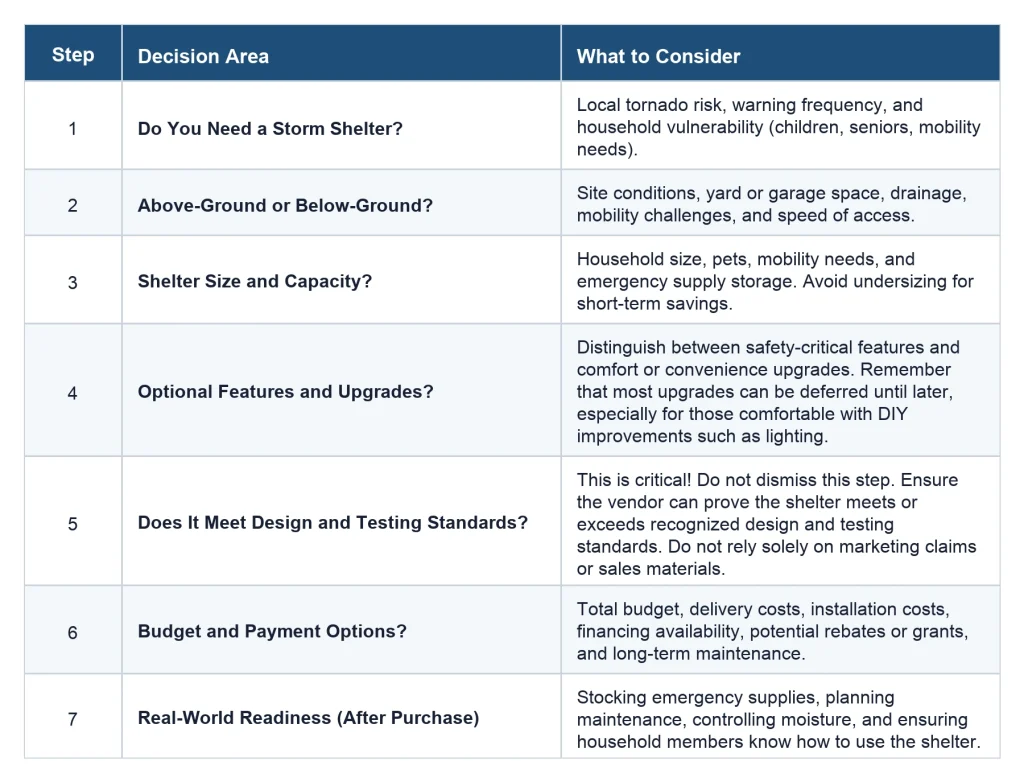
If you follow these steps, your decision will become clearer and far less stressful!
A storm shelter is a serious investment, but it’s also one of the few home upgrades that can truly protect your family and change the outcome of an extreme weather event.
Final Thoughts
The best way to make an informed buying decision is to rely on solid research rather than pressure-based or sales-driven messaging.
What additional factors need to be considered in this guide? What questions do you have about selecting and buying a storm shelter? Comment below or reach out to me through the contact form and I’ll try to help.