
When you invest in a storm shelter, you are purchasing protection and peace of mind for one of the most extreme and violent weather events on earth. All shelters are not created equal, and not all manufacturers follow the strict standards that ensure real tornado survivability.
This article explains how storm shelters are tested, how the ICC 500 and FEMA P-361 standards work, and why compliance is essential. Most importantly, it will help you understand why any shelter you purchase should meet or exceed these requirements to provide protection against an EF-5 tornado.
Why Proper Testing Matters More Than Most Homeowners Realize
Tornado winds can exceed 250 mph, producing deadly projectiles and pressures that can rip apart even well-constructed homes. During these moments, your storm shelter becomes your family’s true defense.
A shelter that is not tested, or uses untested substitute doors, anchors, or wall systems, may:
- Fail under debris impact
- Deform under wind pressure
- Roll over or detach from its slab
- Experience catastrophic hinge or deadbolt failure
- Permit missile penetration into the interior
These failures are not speculation. They have occurred in real storms. Here is one example from an EF-4 tornado that struck Mayflower, Arkansas, on April 27, 2014, where a storm shelter that did not meet engineering and design standards failed.
That is why ICC 500 testing exists. And it’s why shelters that “look sturdy” or “feel heavy” should not automatically be considered safe. How storm shelters are tested matters. Without accredited testing, a shelter’s performance is left to chance. A shelter that isn’t tested may not be safe.
A manufacturer will always be able to provide documentation that shows their shelter passed certification testing.
What Standards Govern Storm Shelter Testing?
ICC 500 – The Official Testing and Engineering Standard
The ICC/NSSA Standard for the Design and Construction of Storm Shelters (ICC 500) outlines the performance requirements for:
- Debris impact resistance
- Wind pressure loading
- Structural integrity
- Anchorage and overturning resistance
- Doors, windows, frames, and hardware
- Mechanical, ventilation, and egress elements
ICC 500 is adopted into the International Building Code (IBC) and International Residential Code (IRC), making it the code-recognized testing standard in the United States.
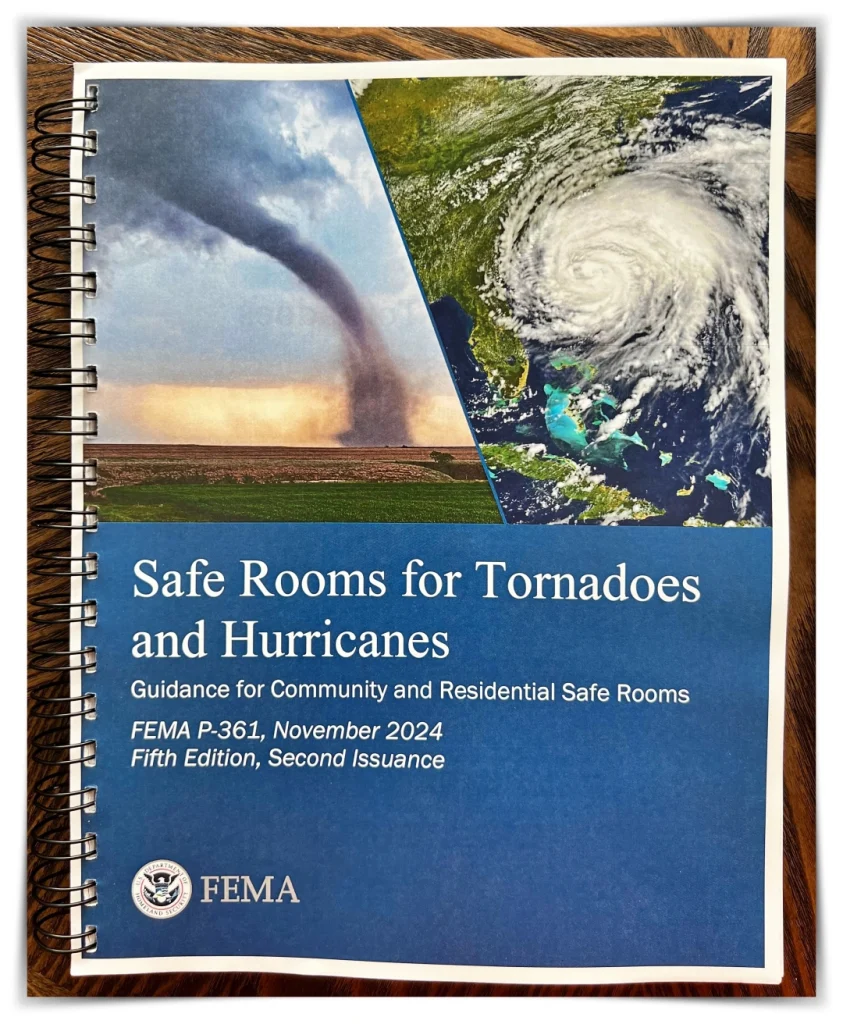
FEMA P-361 – The Safe Room Design and Operation Standard
FEMA P-361 does not create its own debris or pressure tests. Instead, FEMA:
- Requires ICC 500 compliance
- Adds additional safe-room considerations
- Outlines funding, siting, occupancy, and operational requirements
- Ensures consistency for shelters used in public facilities or FEMA-funded projects
A shelter that meets FEMA P-361 is considered a “near-absolute protection” safe room, offering the highest possible life-safety standard.
How Storm Shelters Are Tested (What Homeowners Should Know)
Testing simulates the extreme conditions that occur during violent tornadoes, and manufacturers must prove durability through physical laboratory testing, not calculations alone.
Debris Impact Testing (15-lb Nominal 2×4 Missile Test)
This is the test most homeowners recognize, and for good reason. It represents the violent debris produced by an EF-5 tornado.
How the test works:
- A 15-lb nominal 2×4 is fired like a missile
- 80-100 mph into vertical surfaces (walls and doors)
- 53-67 mph into horizontal surfaces (roof)
- Residential shelters that comply with FEMA P-361 must be tested at the highest end of each range (67 and 100 mph)
Impact locations include:
- Door center
- Hinges
- Deadbolts
- Seams
- Vents or louvers
- Window or glazing areas
Passing requirements:
- No perforation
- No spalling into the safe room
- No hinge, bolt, or frame failure
- Door must remain latched and functional
A single failure at any location is a failed test.
Wind-Pressure Structural Testing
Tornadoes exert massive pressure differentials that can rip walls away or implode structures.
Testing labs apply:
- Positive pressure (pushing inward)
- Negative pressure (pulling outward)
- Load levels matching 250 mph tornado winds
Shelters must not:
- Fracture
- Collapse
- Deform excessively
- Lose their anchorage
The goal is complete structural envelope integrity.
Anchorage and Load Path Verification
Even a strong shelter fails if it detaches from the foundation.
Engineers must verify anchorage can resist:
- Uplift
- Sliding
- Overturning
Load pathways must be continuous from roof to walls to slab to ground.
Many shelter failures in real tornadoes occur because the shelter wasn’t anchored as specified in its tested configuration. This is another reason documentation is crucial.
ICC 500 vs. FEMA P-361: What’s Required to Be a “Safe Room”?
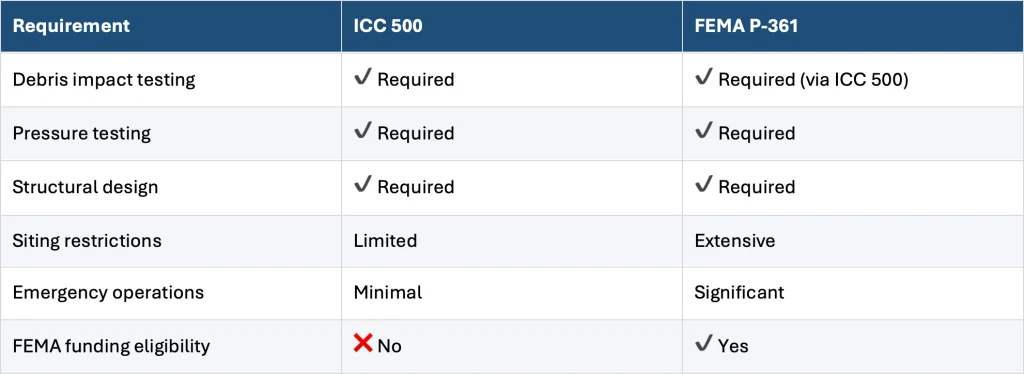
Key point: A Manufacturer cannot claim a shelter is “FEMA compliant” unless it meets both ICC 500 AND FEMA P-361.
Where Legitimate Storm Shelter Testing Takes Place
Texas Tech University’s National Wind Institute was instrumental in the development of tornado debris testing. However, Texas Tech no longer offers debris impact testing for ICC 500 compliance. They now focus on research and no longer on compliance certification.
Only a few accredited laboratories in the U.S. perform official ICC 500 debris-impact and structural tests.
These include:
Intertek
- ICC 500 debris-impact testing
- Structural pressure testing
- Certification & labeling
- Widely used in the shelter industry
UL (Underwriters Laboratories)
- Tornado debris testing
- Full ICC 500 compliance evaluations
- Continued production audits
ICC-ES
- Official ICC testing programs
- Evaluation reports (ESRs) trusted by code officials
- Independent certification of components and full shelters
A legitimate shelter manufacturer can always provide documentation from one of these organizations.
How Manufacturers Prove Compliance
A trustworthy manufacturer follows this process:
Step 1 – Engineering Design – Engineers design the shelter to ICC 500 wind load and missile requirements.
Step 2 – Laboratory Prototype Testing – Doors, walls, roofs, vents, and anchoring systems are physically tested.
Step 3 – Evaluation Reports / Listings – Testing agencies issue official reports documenting compliance.
Step 4 – Production Labeling – the Manufacturer includes labeling on the shelter that verifies it has been tested and complies with the FEMA P-361 and ICC-500 standards.
Step 5 – Installation According to Tested Configuration – Using untested anchors or substituting doors voids compliance and can lead to failure.
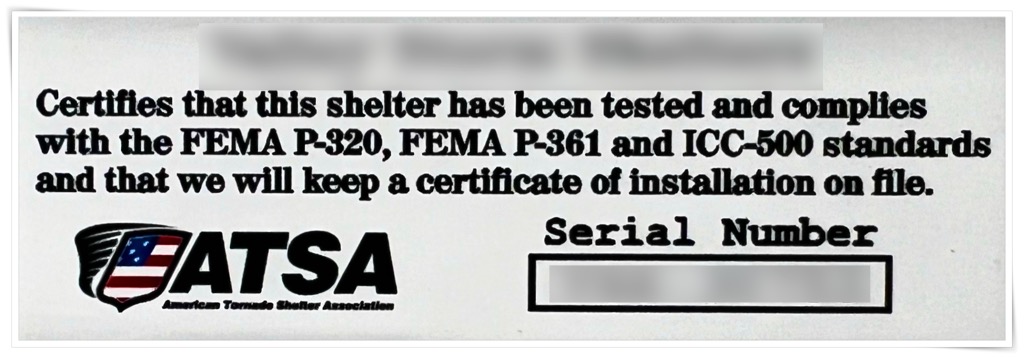
Why It’s Critical That Your Shelter Meets or Exceeds Standards
Substandard shelters on the market may:
- Use untested doors
- Rely on light-gauge steel not rated for impact
- Substitute cheaper anchors
- Have no documentation
- Cannot provide engineering calculations
- Cannot show testing reports
These shelters may fail catastrophically, even if the manufacturer claims otherwise.
The storm shelter manufacturer must be able to prove compliance. Don’t just accept their claim!
Buyer Checklist: What Every Homeowner Should Ask
Before purchasing a shelter, ask:
- Was this shelter tested to ICC 500?
- Which lab performed the testing? Intertek, UL, ICC-ES, or NTA?
- Can you provide the test report or evaluation report number?
- Was the door assembly tested as a complete unit
- Are the anchors used in installation identical to those used during testing?
- Does this shelter meet FEMA P-361 safe-room requirements?
- Are all components permanently labeled?
If a manufacturer cannot answer these questions clearly, consider that a red flag.
Are You Prepared?
Storm shelters save lives, but only when they are properly engineered, rigorously tested, and certified by accredited laboratories. With Texas Tech no longer offering compliance testing, today’s manufacturers rely on Intertek, UL, and ICC-NTA to validate performance.
For your family’s safety, demand full documentation.
As I mentioned earlier, how storm shelters are tested is really important and should not be taken lightly. A shelter is not a shelter unless the manufacturer can prove the shelter was designed and tested to withstand real tornado conditions through accredited laboratory documentation.
Hopefully, this article equipped you to better evaluate your shelter options with testing and safety standards in mind. After learning how shelters are tested, what questions do you now have? Please comment below or you can also reach out to me directly.