
Two of the most common questions from homeowners who are considering a steel storm shelter is: “What happens if lightning strikes it while I’m inside?” Or, “What happens if live electrical wires fall on it while my family is inside?” These are great questions. After all, steel is conductive, and storms bring not only tornadoes but also heavy lightning and downed power lines.
Fortunately, science and decades of real-world evidence, gives us a clear answer: steel storm shelters are safe from lightning strikes and electrical hazards, thanks to the Faraday Cage Effect. This article will explain the Faraday Cage Effect, how it applies to storm shelters, and why myths about electrocution risks inside a steel shelter simply don’t hold up.
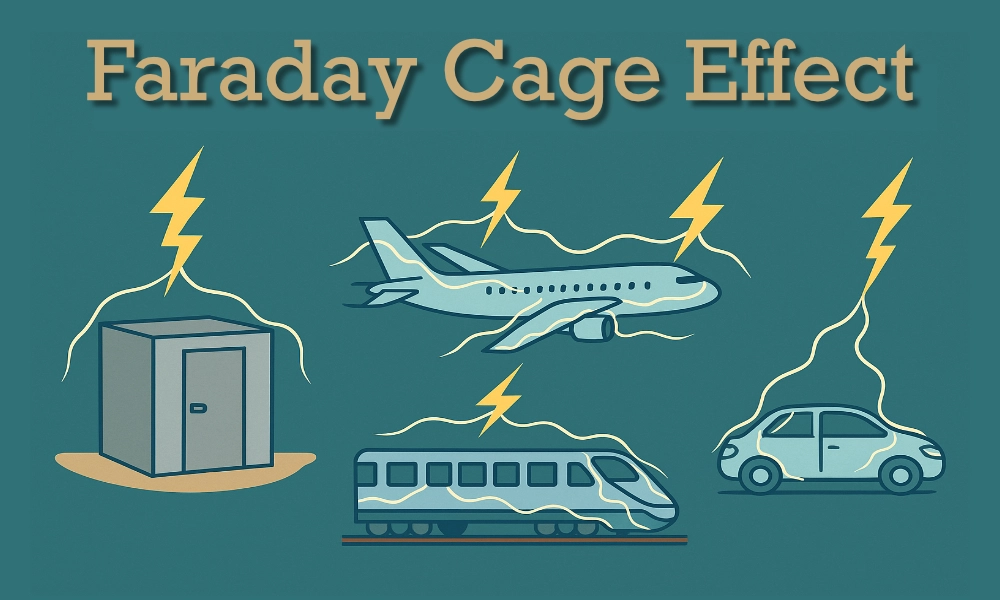
What Is the Faraday Cage Effect?
The Faraday Cage Effect, named after 19th-century scientist Michael Faraday, describes the way an enclosed conductive structure distributes electrical charges around its exterior.
When lightning or electricity strikes a conductive enclosure, the electrical current travels over the outside surface of the structure and is safely dissipated into the ground. The interior remains shielded and unaffected.
This principle is why:
- Airplane cabins remain safe during lightning strikes.
- Automobiles (with metal frames) protect occupants even when struck by lightning.
- Metal communication towers can be struck multiple times a year without harming the equipment inside.
A properly designed steel storm shelter behaves just like a Faraday cage. It shields the people inside from dangerous electrical energy.
For a more scientific explanation of the Faraday Cage Effect (including why mobile phones and radios do not work well in a steel storm shelter), check out this interesting YouTube video called “Faraday Cage Explained. A Deepish Dive.”
Debunking the Myth: “Steel Shelters Can Electrocute You”
The biggest misconception about steel storm shelters is that they “attract” lightning or that being inside one during a strike increases the risk of electrocution. Let’s break this down:
- Lightning is unpredictable – It strikes the highest conductive point nearby, but it doesn’t “seek out” steel more than other tall objects. If your shelter is buried or anchored low to the ground, it’s not any more of a target than a nearby tree or utility pole.
- Electricity follows the path of least resistance: on the outside – If lightning strikes a steel shelter, the current immediately flows across the exterior shell, then down into the earth. This is the same principle that keeps airline passengers safe. The electrical energy doesn’t “enter” the shelter cavity or build up inside.
- No direct conduction to occupants – Unless someone inside is physically connected to both the steel wall and the ground outside (an unlikely scenario), there is no pathway for current to travel through the body. The air inside is an insulator, so people remain completely safe.
In fact, engineers who design storm shelters intentionally follow ICC 500 and FEMA P-361 standards, which ensure proper construction, anchoring, and safety—including considerations for lightning and electrical hazards.
What About Downed Power Lines?
Another concern is whether a storm shelter could become dangerous if a live power line falls across it. Here’s why that isn’t a risk:
- Steel shelters are grounded – Just like household electrical panels, storm shelters made of steel are bolted or anchored into a concrete slab, which naturally conducts electricity away.
- Electricity still flows along the exterior – Even if a live wire contacts the shelter, the electrical current clings to the outer surface and flows into the ground.
- The interior remains insulated – Again, the principle of the Faraday Cage Effect ensures that people inside are not exposed to shock or electrocution.
The only practical safety advice is this: if you see a downed power line on your shelter after a storm, wait for utility crews to remove it before leaving the shelter or touching the outside. This is no different from how you’d treat a car or a metal fence with a line draped across it.
Real-World Proof: Trains, Planes, and Automobiles!
The best everyday analogy for a steel storm shelter is your car. Automobiles, made largely of steel frames, are struck by lightning thousands of times each year worldwide. Occupants rarely suffer injury because the lightning travels around the car body, not through the passenger compartment. This is the same for passenger trains, school and commercial buses, and planes. A few caveats on automobiles: soft-tops and convertibles won’t offer the same protection since they lack the necessary metal surrounding for the Faraday Cage effect. Fiberglass or other nonmetallic automobiles may also offer less protection.
Similarly, commercial airplanes are struck by lightning on average once per year per plane. Yet passengers inside remain completely unharmed. Why? Because the airplane’s aluminum fuselage creates the same Faraday Cage protection that storm shelters offer.
If trains, planes, and automobiles (all of which have far more exposure to lightning than a storm shelter) are safe from lightning, then a steel storm shelter anchored to the ground is just as safe!
Addressing Homeowner Concerns Directly
Let’s tackle some of the most common “what if” scenarios:
- What if lightning strikes directly on top of my shelter? You’ll hear a loud noise, but the current will flow across the steel exterior and into the ground. Inside, you won’t feel a shock.
- Could sparks jump inside through the ventilation? No. Vent openings in FEMA-rated shelters are designed with screens and coverings that prevent arcing or intrusion of electrical current.
- What if I touch the walls during a lightning strike? Even if your hand is against the wall, the electrical current prefers the outer surface. It won’t pass through to the interior side.
- Could electronic devices inside be affected? Possibly, but not necessarily. The Faraday Cage Effect may even protect sensitive electronics inside the shelter by blocking external electromagnetic interference.
The Bottom Line
Steel storm shelters are one of the safest places to be during a severe storm. Not only can they withstand the violent winds and flying debris of an EF5 tornado, but they also protect you from lightning and electrical hazards.
The Faraday Cage Effect ensures that electricity flows harmlessly around the outside of the shelter, leaving the inside perfectly safe. Myths about being electrocuted inside a steel storm shelter have no basis in science or real-world experience.
If you’re a homeowner considering storm shelter options, rest assured: a steel storm shelter that is constructed and anchored according to ICC 500 and FEMA standards is safe, both structurally and electrically.
What additional concerns do you have about the safety of steel storm shelters and lightning strikes or downed power lines? Comment below or reach out to me directly.