
When tornadoes strike, the news reports often describe them using terms like “EF-2” or “EF-5”. But many homeowners are left asking a simple question: What is the EF scale all about, and what do those ratings really mean?
The Enhanced Fujita (EF) Scale is the system used by the National Weather Service (NWS) in the United States to classify tornado intensity based on damage. It does not measure tornado wind speed in real time. Instead, it estimates the strength of the tornado afterwards by assessing the overall impact of the storm on buildings, trees, and other structures.
Understanding what the EF scale represents (and what it doesn’t) is important for interpreting tornado reports, assessing regional risk, and making informed preparedness decisions. This guide explains how the EF scale works, how tornado ratings are assigned, and why even lower-rated tornadoes are still dangerous.
If you’re researching tornado preparedness and considering long-term protection options for your home, I recommend starting with my Storm Shelter Buying Guide. This guide walks through the key safety standards, design factors, and decision points that homeowners should understand before making a buying decision.
What Is the EF Scale, Anyway?
The Enhanced Fujita (EF) Scale replaced the original Fujita Scale on February 1, 2007. The original version, often referred to as the F-Scale (i.e., F2 tornado, F4 tornado), was introduced in 1971 by meteorologist Dr. Ted Fujita, working with Allen Pearson of the National Severe Storms Forecast Center (now the NOAA/NWS Storm Prediction Center). The NWS adopted it widely in the early 1970s. The newer EF Scale builds on that foundation, offering more accurate wind-speed estimates that better reflect the construction standards and methods of modern-day buildings.
Rather than measuring wind directly, the EF Scale uses damage indicators, such as homes, schools, trees, and power poles, to estimate the wind speeds likely required to cause the observed destruction. The EF Scale does not use actual wind measurements.
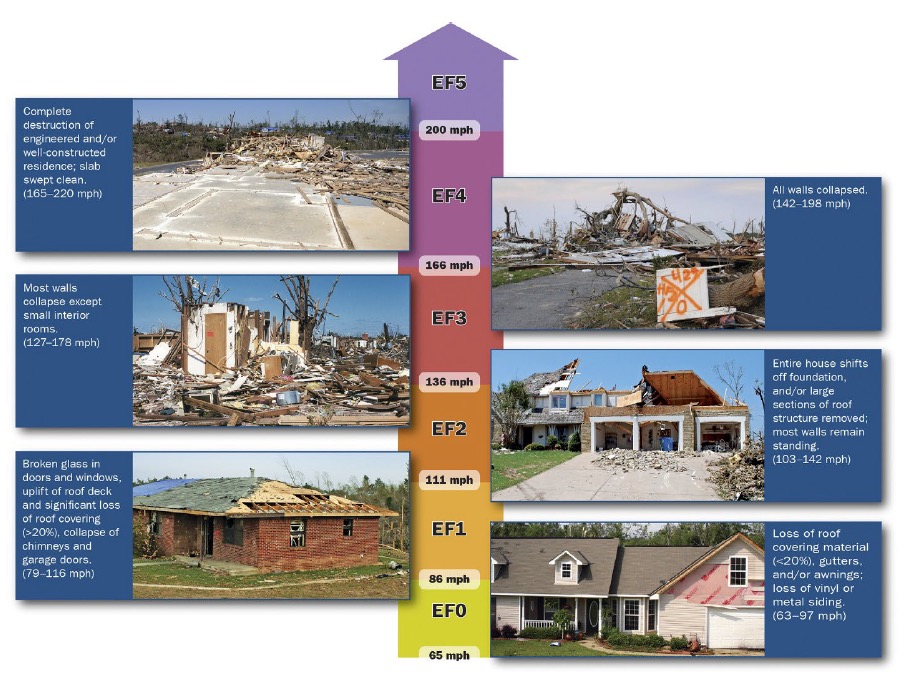
There are six EF-ratings, which range from EF-0 (weakest) to EF-5 (strongest). Typical damage to be expected for each rating is shown in the image below.
How EF Ratings Are Determined After a Tornado
Once a tornado has passed, trained survey teams, most often from the National Weather Service (NWS), begin a careful, systematic review of the damage left behind. The goal is not to measure the tornado’s winds directly (which is nearly impossible once the storm has passed) but rather to infer the most likely wind speeds based on what the tornado actually did to real structures and objects along its path.
Here’s how that process works:
- Damage Indicators (DIs): Survey teams use a standardized set of 28 different “damage indicators,” which include buildings of various types (single-family homes, schools, motels, strip malls, etc.), mobile homes, barns and outbuildings, utility poles, trees, and more. Each DI represents a specific type of structure or object that, under winds, responds in a predictable way based on its design and construction.
- Degrees of Damage (DoD): For each DI, there are up to eight “degrees of damage” that range from light cosmetic harm to total destruction. Teams carefully document how each DI was affected. For example, a single-family home in one area of the tornado path might have lost only roof shingles, while another home along the path might have a destroyed roof and collapsed walls.
- Estimating Wind Speeds: Using these observed patterns, surveyors compare what they see to detailed tables that correlate specific damage levels with estimated wind speed ranges. This allows them to estimate the peak 3-second gusts most likely responsible for that damage. Unlike simple eyeballing, this method ties what happened on the ground back to engineering knowledge about how structures behave under wind loads.
- Final EF Rating: After reviewing multiple locations along the path and cross-checking several indicators, the team estimates the most likely highest wind speeds and assigns a final EF rating (EF-0 through EF-5) based on those estimates.
This process underscores several important realities that many people misunderstand:
- Two tornadoes with similar winds may receive different ratings simply because one encountered more damage indicators than the other.
- Tornadoes in rural areas may be rated lower because there are fewer structures to survey, even if the winds were otherwise extreme.
- Tornado width, shape, or appearance has no bearing on the official EF rating.
- The EF Scale reflects what the tornado did, not how it looked or how fast it might have been traveling on the ground, or how long it stayed on the ground.
For readers who want to explore the more technical side of tornado evaluation, the NWS and NOAA explain this methodology in depth, including the full list of damage indicators and how they’re applied in real damage surveys. Check out the link below for details.
👉Enhanced Fujita Scale– includes lower/upper 3-second wind gusts for each EF rating, information on how EF ratings are assigned, and links to definitions of all 28 damage indicators.
EF-0 and EF-1 Tornadoes: Often Underestimated
EF-0 and EF-1 tornadoes are frequently described as “weak,” but that label can be misleading.
Typical damage includes:
- Loss of roof covering materials
- Damaged gutters and awnings
- Broken tree limbs
- Collapsed chimneys or garage doors
Even at these lower ratings, tornadoes can:
- Produce dangerous flying debris
- Damage mobile homes severely
- Cause serious injury or death
Many tornado fatalities occur in EF0–EF1 storms, often due to debris impact or structural failure in vulnerable buildings.
The lesson is simple: the threat of a tornado should never be underestimated.
EF-2 and EF-3 Tornadoes: Serious Structural Threat
EF-2 and EF-3 tornadoes mark the point where structural integrity is commonly compromised.
Damage often includes:
- Roofs torn from homes
- Exterior walls collapsed
- Vehicles overturned or displaced
- Manufactured homes destroyed
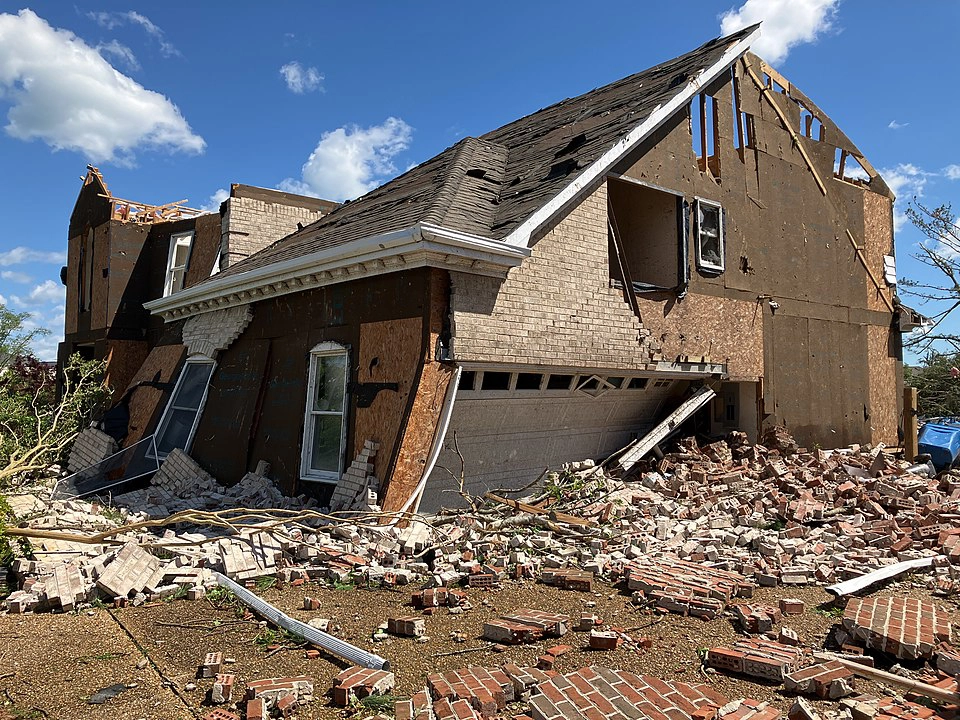
At these levels, interior rooms in typical homes may no longer provide reliable protection. Structural failures allow wind and debris to penetrate quickly, turning ordinary objects into dangerous projectiles. The photo below shows home damage from an EF-3 tornado that hit Virginia Beach, VA, on April 30, 2023.
For homeowners, EF-2 and EF-3 tornadoes represent a significant survival threshold where shelter quality becomes critically important.
EF-4 and EF-5 Tornadoes: Catastrophic Destruction
EF-4 and EF-5 tornadoes produce the most extreme damage seen in tornado events.
Common effects include:
- Homes completely leveled
- Foundations swept clean
- Vehicles thrown long distances
- Large debris embedded in structures
Survival in these storms depends almost entirely on access to properly designed shelters or safe rooms. Traditional home construction is rarely capable of withstanding these forces.
While EF-4 and EF-5 tornadoes are relatively rare, they account for a large portion of tornado fatalities due to their severity.
Why EF Ratings Can Be Misleading to the Public
It’s easy to assume that a higher EF rating automatically means a tornado was larger, longer-lasting, or more dangerous. Similarly, you might think that a lower rating means it was weaker or less threatening. Many people also believe the EF rating predicts how dangerous a tornado will be before it happens. In reality, these are all incorrect assumptions.
EF ratings are assigned after a tornado has passed, based only on the damage that can be observed and documented. The scale does not directly measure wind speed, and it does not account for how long the tornado stayed on the ground, how wide it became, or how many people were in its path.
Because of this, two tornadoes can receive the same EF rating while behaving very differently. One may be brief and narrow, while another may be wide and long-tracked. Yet, both of these tornadoes may cause similar maximum damage to certain structures. Likewise, a lower-rated tornado can still cause serious injuries or fatalities if it strikes in a populated area, while a violent EF-4 or EF-5 tornado may cause fewer deaths or injuries if it remains in rural terrain.
A few examples may help to illustrate this more clearly.
Same EF Rating – Different Behavior
Two tornadoes can both be rated EF-2, yet:
- One may be wide, long-tracked, and fast-moving
- The other may be narrow, short-lived, and slow-moving
If both produce similar maximum damage to structures, they may receive the same EF rating even though their overall behavior was very different. The EF scale measures damage, not total storm characteristics.
Why a “Weak” Tornado Can Cause Major Harm
An EF-0 or EF-1 tornado can:
- Collapse mobile homes, RVs, etc.
- Send debris through the air at deadly speeds
- Strike densely populated neighborhoods
Because the EF rating reflects actual damage and not population exposure, a lower-rated tornado can still cause serious injuries or deaths if it hits people directly.
Why A Violent Tornado Can Cause Fewer Impacts To People
An EF-4 or EF-5 tornado may:
- Remain over farmland or forests
- Miss towns entirely
- Destroy few or non-occupied structures
The EF rating reflects extreme damage where it occurred. It doesn’t assess how many people were affected. So, a tornado can be “violent” while causing limited impact to people.
In short, EF ratings describe damage intensity, not overall risk to people. Location, population density, building quality, warning time, and preparedness all play major roles in determining how dangerous a tornado truly is.
That is why every tornado warning should be taken seriously. The EF number that appears later in reports does not change the fact that any tornado has the potential to threaten lives.
EF Scale vs Tornado Preparedness
Tornado preparedness should never be based on what EF rating a storm might eventually receive. When a tornado warning is issued, critical details are still unknown. You do not know the tornado’s final strength, its exact path, how wide it may become, or which homes, buildings, or neighborhoods could be directly affected. Even small changes in track can mean the difference between a near miss and a direct hit.
You also cannot know which structures may fail. Two homes built side by side can perform very differently in extreme winds. Debris from surrounding buildings, vehicles, and trees often causes more injuries than the wind itself. These uncertainties make it impossible to safely “judge” a tornado that is on the ground.
Preparedness is not about predicting storm strength. It is about reducing risk exposure. The moment a warning is issued, the safest decision is to move to shelter immediately. Waiting for visual confirmation, listening for reports of damage, or assuming “it is only a small tornado” only wastes precious time.
This is why tornado safety guidance consistently emphasizes immediate sheltering whenever a warning is issued. The EF rating may become part of the historical record later, but it provides no protection in the moment that matters most.
For broader planning, storm shelter options, and practical steps every household should consider, see our full Tornado Preparedness Guide.
Why Modern Storm Shelters Are Designed for EF-5 Rated Threats
Storm shelters and safe rooms are designed, constructed, and installed to withstand the most extreme conditions tornadoes can produce. Unlike typical residential construction, modern shelters that meet ICC standards and FEMA guidelines must comply with well-defined performance standards that consider everything from how debris impacts are simulated to how the structure is anchored to the ground.
These standards include:
🔹 High-velocity debris impact resistance
Shelters are tested by firing “missiles”, traditionally a 15-lb 2×4, at speeds up to around 100 mph into walls and doors to replicate the violent debris found in tornadoes. The shelter must resist penetration, tearing, or deformation under these conditions.
🔹 Structural anchoring and load-path requirements
A shelter must remain anchored to its foundation even under extreme uplift, overturning, and sliding forces. This continuous load path, from roof to walls to foundation, ensures the shelter stays intact instead of shifting under tornado winds.
🔹 Door and hardware reinforcement
Doors, hinges, deadbolts, and frames undergo rigorous testing because they are common failure points. They must remain operable and secure under both debris impact and wind pressure.
🔹 Pressure resistance testing
Tornado winds create dramatic fluctuations in air pressure. Shelters and their components are tested for both positive and negative pressures to ensure they don’t fracture, separate, or collapse under forces equivalent to winds in the most violent tornadoes.
Because most tornado injuries and deaths are caused by flying debris, not the wind itself, this focus on debris resistance is critical. Shelters are designed to protect occupants even during violent EF-5 tornadoes.
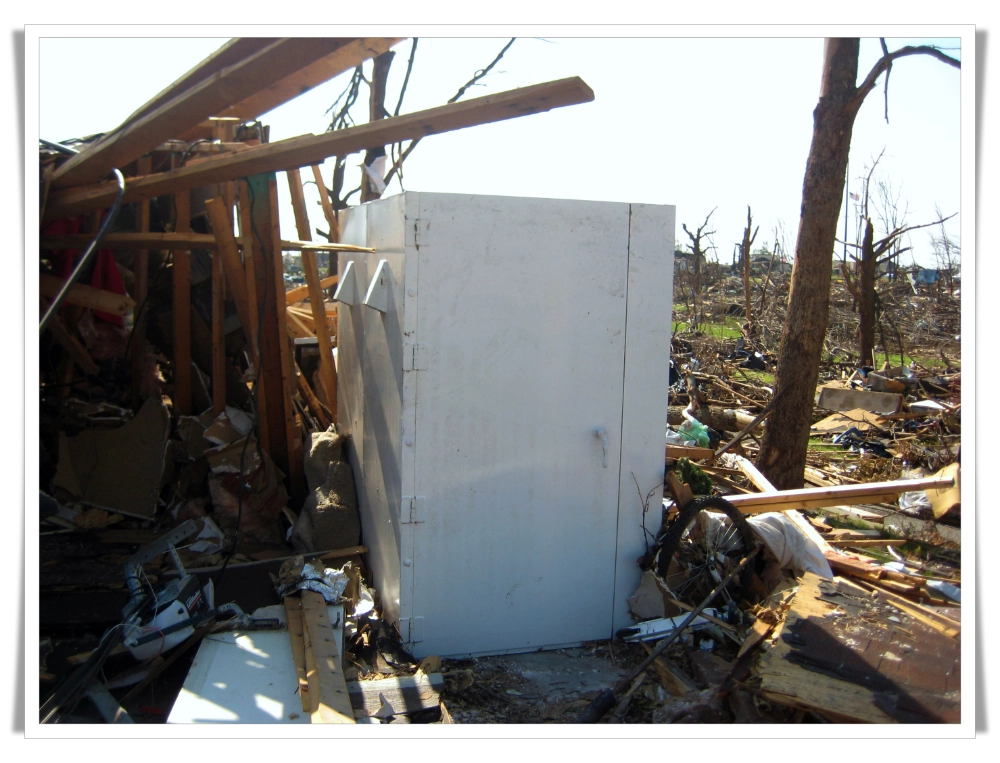
By contrast, ordinary homes are not engineered to meet these standards. Standard residential construction does not include tested anchoring systems, impact-rated doors, or materials designed to withstand extreme windborne debris. That’s why a storm shelter provides a level of protection a typical house simply cannot match in a severe tornado.
To understand how storm shelters are tested, check out my full article on the topic:
👉 How Storm Shelters Are Tested For EF-5 Tornadoes
Common EF Scale Myths
Myth 1: Only EF-4 and EF-5 Tornadoes Are Deadly.
Reality: Even so-called “weak” tornadoes regularly cause injuries, fatalities, and serious property damage. EF-0 and EF-1 tornadoes can collapse mobile homes, destroy roofs, and send debris flying at dangerous speeds. Many tornado deaths occur in lower-rated storms simply because people underestimate the risk or are caught without adequate shelter.
—
Myth 2: If it’s Only An EF-1, I’m Safe.
Reality: Structural vulnerability matters far more than the EF rating. A poorly built home, a mobile home, or an upper floor in a house offers very limited protection, even in lower-rated tornadoes. It’s also important to remember that EF ratings are assigned afterthe tornado, not during it. While meteorologists can use radar to determine that a tornado is happening, current technology does not enable a precise wind speed estimate in real-time. The EF rating is determined by a post-storm damage assessment.
—
Myth 3: You Can Tell How Strong A Tornado Is By How It Looks.
Reality: A tornado’s appearance can be very misleading. Some narrow, rope-like tornadoes have produced intense damage, while large, dramatic wedge tornadoes have occasionally caused less severe impacts depending on where they traveled. Darkness, rain wrapping, distance, and perspective all affect how a tornado appears, making visual judgment unreliable and dangerous.
—
Myth 4: My House Can Handle Most Tornadoes.
Reality: Most residential homes are not engineered to withstand tornadic winds or the high-speed debris those winds create. Roofs, garage doors, windows, and exterior walls are common points of failure in a home. Once these fail, internal pressure and debris penetration greatly increase the risk of structural collapse. This is why properly designed and installed storm shelters are the safest option during any tornado warning. If a storm shelter is not available, then interior rooms (closets, bathroom, hallway) or a basement would be the next best choice.
Here’s the key takeaway: EF ratings describe damage, not danger to people. You should take every tornado warning seriously and seek immediate shelter.
How Homeowners Should Use EF Information
The EF Scale is most useful for:
- Understanding historical tornado risk in your area
- Comparing past storm impacts
- Learning how different structures perform
- Supporting preparedness planning and storm shelter needs assessment
It should not be used for:
- Deciding whether to take shelter
- Predicting survival outcomes
- Assuming certain tornadoes are safe
Preparedness is about what could happen. Not what you think is likely to happen.
How EF Ratings Relate to Storm Shelter Decisions
Many homeowners begin exploring shelter options after learning:
- Their region has experienced recent EF-2 or higher tornadoes, reminding them that damaging tornadoes are not just rare, historical events but ongoing risks in their area.
- Nearby homes have suffered structural failure, which highlights how quickly standard construction can be compromised by tornadic winds and debris.
- Warning times are limited, leaving little opportunity to relocate to safer buildings once a tornado is approaching.
- Family mobility is a concern, especially for children, elderly relatives, or anyone with physical limitations who may struggle to reach a safe shelter quickly.
- Neighboring communities have installed public or community shelters, signaling a broader recognition that traditional homes do not always provide adequate protection.
- They realize mobile homes perform poorly even in lower-rated tornadoes and that most homes are not capable of withstanding stronger tornadoes, reinforcing the need for purpose-built protection.
If you are evaluating whether a shelter makes sense for your household, this article may help:
👉 Do I Even Need A Storm Shelter?
Final Thoughts: What the EF Scale Really Teaches Us
The Enhanced Fujita Scale does not exist to scare people. It exists to help scientists, engineers, and emergency planners better understand how tornadoes interact with the built-out environment, and how structures succeed or fail under extreme wind and debris forces.
What it ultimately teaches is this:
- Even so-called weaker tornadoes are capable of causing serious injuries, fatalities, and major damage.
- Structural protection matters far more than assumptions about storm strength.
- Flying debris, not wind alone, is responsible for most tornado injuries.
- Preparedness should never depend on an expected EF rating.
Tornadoes will always be unpredictable in their path, timing, and behavior. But preparedness does not have to be uncertain. Thoughtful planning, proper sheltering, and informed decisions can dramatically reduce risk long before a warning is issued.
By understanding what the EF Scale truly represents (and what it does not), homeowners can replace uncertainty with knowledge, hesitation with confidence, and fear with thoughtful, practical preparation.
Before reading about the EF scale, what did you assume tornado ratings actually meant, and did anything in this article change that perspective?
How does understanding the EF scale affect the way you think about tornado preparedness in your own home?
Please feel free to leave a comment below, or you can reach out to me directly with questions.